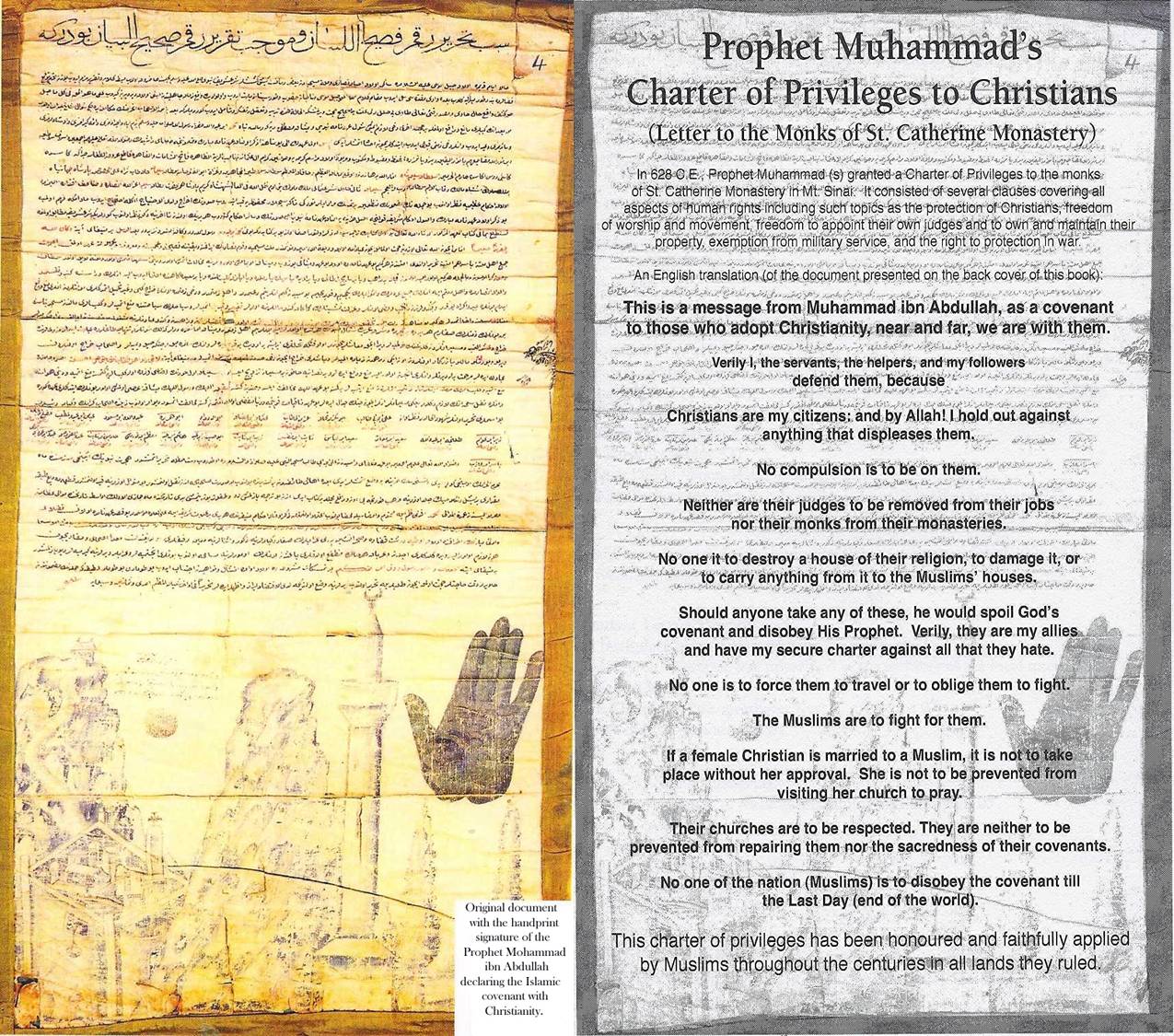
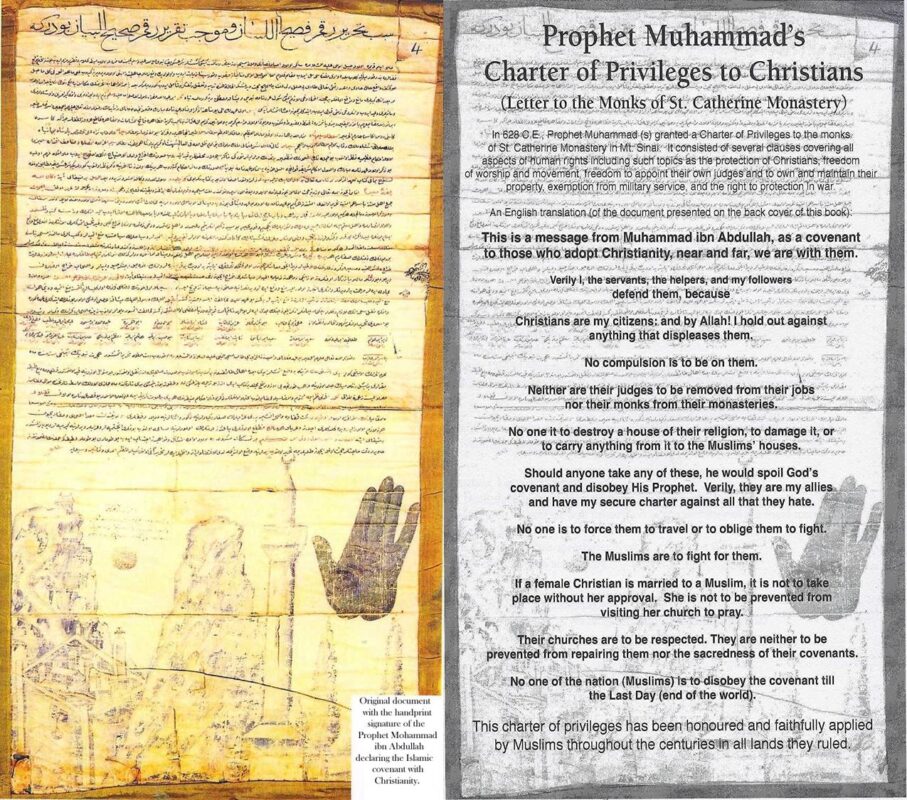
At the foot of Mount Sinai in Egypt stands an ancient structure known as Saint Catherine’s Monastery. Behind its formidable stone walls lies the memory of a promise that transcends time. In the year 628 CE, Prophet Muhammad (PBUH) entrusted a document that would later become the gold standard for religious harmony on earth. This document is known as the Ashtiname (The Covenant).
The Ashtiname is not merely a piece of correspondence. It is a constitutional charter born from the depths of prophetic wisdom. While other civilizations at the time were still using the sword to enforce belief, Islam offered a canopy of protection for those of different faiths.
The following is the full text of Prophet Muhammad’s promise to the Christians:
THE TEXT OF THE COVENANT (ASHTINAME)
“This is a message from Muhammad ibn Abdullah, as a covenant to those who adopt Christianity, near and far, we are with them.
Verily I, the servants, the helpers, and my followers defend them, because Christians are my citizens; and by Allah! I hold out against anything that displeases them.
No compulsion is to be on them. Neither are their judges to be removed from their jobs nor their monks from their monasteries, nor are the hermits to be displaced from their cells.
No one is to destroy a house of their religion, to damage it, or to carry anything from it to the Muslims’ houses. Should anyone take any of these, he would spoil God’s covenant and disobey His Prophet.
Verily, they are my allies and have my secure charter against all that they hate.
No one is to force them to travel or to oblige them to fight. The Muslims are to fight for them. If a female Christian is married to a Muslim, it is not to take place without her approval. She is not to be prevented from visiting her church to pray.
Their churches are to be respected. They are neither to be prevented from repairing them nor the sacredness of their venerated places.
No one of the nation (Muslims) is to disobey the covenant till the Last Day (Day of Judgment).”
The Wisdom Behind the Promise: Islam as a Protector, Not an Oppressor
The essence of the Ashtiname is the affirmation that Islam did not come to erase other religions, but to guarantee the right to life and dignity for every human being. There are several fundamental lessons we can draw from this manifesto:
1. Protection as an Act of Worship Prophet Muhammad did not just give a verbal promise; he linked the protection of Christians to obedience to Allah. The phrase “Should anyone take any of these, he would… disobey His Prophet” shows that guarding churches and respecting the rights of Christians is part of a Muslim’s integrity of faith. Injustice, in this context, is not just a social issue but a serious violation of Divine law.
2. Sanctuary for Spiritual Institutions The command not to remove bishops or disturb monks in their seclusion shows that Islam deeply respects the spiritual authority of other religions. The Prophet granted full autonomy for Christians to manage their religious organizations without interference from Muslim rulers. This was a highly advanced form of religious institutional independence for its time.
3. The Concept of “My Citizens” within Diversity The use of the phrase “Christians are my citizens” erases the barrier between “us” and “them” in the context of citizenship. Under the Prophet’s leadership, a difference in faith did not cause an individual to lose their right to state protection. Furthermore, the Prophet revolutionarily stated that Muslims must fight to protect Christians if they are attacked.
4. A Blow to Modern Fundamentalism In the modern era, we often see individuals who claim to be “most Islamic” yet enjoy harassing the worship of other believers or rejecting the existence of their houses of worship. The Ashtiname is proof that such actions are not acts of defending the religion, but acts of rebellion against the Prophet’s own testament. Those who damage churches or obstruct Christian worship are effectively destroying the heritage of tolerance built by the Messenger of Allah.
Through the Ashtiname, we learn that the greatness of a religion is not measured by how many it subdues, but by how wide it can spread the wings of protection for the weak and the different. It is time for the Muslim ummah to return to this essence: becoming guardians of humanity, exactly as exemplified by the Prophet at the foot of Mount Sinai.